examOS.
Exam CatalogStudy PlansRoadmapsBlogs
Login

ExamOS

Credits PolicyReferral PolicyQuality StandardsPricingPrivacy PolicyTerms of UseContact UsReport a Bug

Follow us

Disclaimer: ExamOS is an independent platform, not affiliated with any certification provider, and does not use or distribute exam dumps.

Back to Blog

Ranked Breakdown

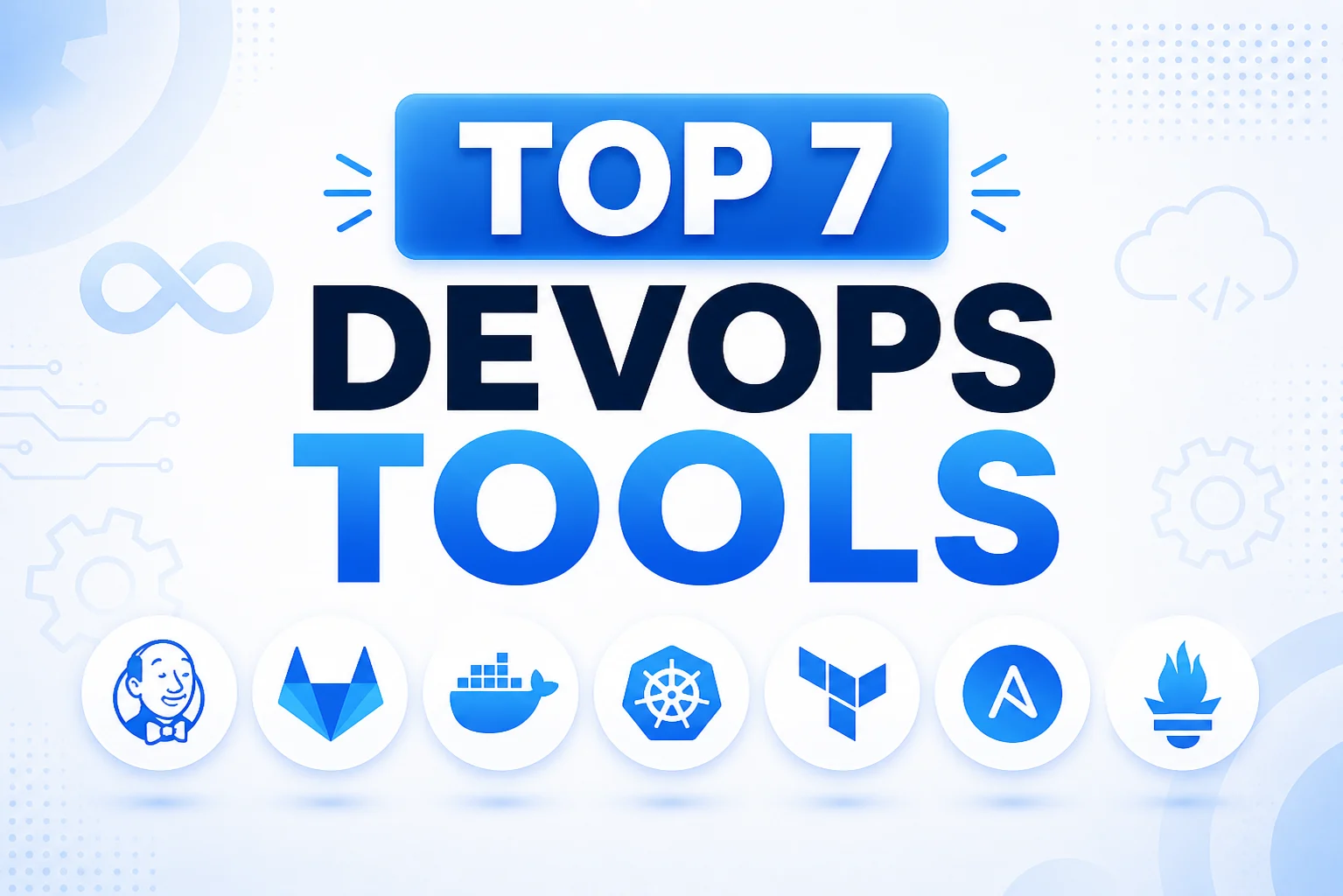
Top 7 DevOps Tools You Must Know in 2026 (Ranked by Real-World Usage)

The DevOps landscape is a mess of logos. Cut through the noise with the top 7 DevOps tools you actually need to learn to get hired.

Priority Order7 ranked items30-Mar-2026
Top 7 DevOps Tools You Must Know in 2026 (Ranked by Real-World Usage)
examOS.Blog
Disclaimer: ExamOS is an independent platform, not affiliated with any certification provider, and does not use or distribute exam dumps.

Top 7 DevOps Tools You Must Know in 2026 (Ranked by Real-World Usage)

The DevOps landscape is a mess of logos. Cut through the noise with the top 7 DevOps tools you actually need to learn to get hired.

If you look at the CNCF (Cloud Native Computing Foundation) landscape, you will see a massive, terrifying grid of hundreds of DevOps tools and logos.

It makes beginners feel like they need to learn 40 different software platforms just to get a job. This is a massive lie.

The reality of DevOps is much simpler. Companies do not want engineers who know a little bit about 40 tools. They want engineers who deeply understand the core pipeline.

If you are trying to break into DevOps or Cloud Automation in 2026, stop learning random tools. Here are the 7 core technologies you actually need to master, ranked by real-world necessity.


1
Rank 1 of 7

Git & GitHub (The Foundation)

DevOps is about treating operations like software engineering. Therefore, everything you do—your infrastructure, your application code, your scripts—must be version-controlled. If you do not know Git, you cannot work in DevOps.

  • What you need to master: Branching strategies, pull requests, merge conflicts, and reverting bad commits.
2
Rank 2 of 7

Linux & Bash (The Operating System of the Cloud)

The vast majority of the internet runs on Linux. The servers you provision, the containers you build, and the CI/CD runners you execute will all be Linux-based.

  • What you need to master: Navigating the file system, managing permissions (chmod/chown), SSH, and writing basic Bash scripts to automate menial tasks.
3
Rank 3 of 7

Terraform (Infrastructure as Code)

Clicking buttons in the AWS or Azure console is fine for learning, but it is banned in production. Terraform is the industry standard for Infrastructure as Code (IaC). It allows you to write declarative code to provision cloud resources consistently across any provider.

  • What you need to master: Providers, state file management, modules, and variables.
4
Rank 4 of 7

Docker (Containerization)

The days of deploying raw code to a virtual machine are mostly over. Docker allows you to package an application and all of its dependencies into a single, standardized container that runs the exact same way on your laptop as it does in production.

  • What you need to master: Writing efficient Dockerfiles, managing image layers, and Docker Compose.
5
Rank 5 of 7

GitHub Actions / GitLab CI (CI/CD Pipelines)

Continuous Integration and Continuous Deployment (CI/CD) is the beating heart of DevOps. It is the automation engine that takes a developer's code, tests it, builds a Docker container, and deploys it to the cloud without human intervention.

  • What you need to master: Writing YAML pipelines, handling secrets securely, and creating multi-stage deployments (Dev -> Staging -> Prod).
6
Rank 6 of 7

Python or Go (Automation Programming)

Bash is great for simple server tasks, but when you need to interact with Cloud APIs, manipulate JSON data, or write complex automation logic, you need a real programming language. Python is the easiest and most widely used; Go is the high-performance standard for cloud-native tooling.

  • What you need to master: Making API requests, manipulating dictionaries/JSON, and error handling.
7
Rank 7 of 7

Kubernetes (Container Orchestration)

Kubernetes (K8s) is the most complex tool on this list. It is used by enterprises to manage, scale, and heal thousands of Docker containers automatically. Note: Do not learn this first. You must understand Docker and networking deeply before K8s will make any sense.

  • What you need to master: Pods, Deployments, Services, Ingress, and basic kubectl commands.

How to Prove You Know These Tools

You cannot learn DevOps by watching videos. You must build a pipeline.

Write a simple Python app, containerize it with Docker, push the code to GitHub, write a GitHub Action to test it, and use Terraform to deploy it to AWS. That single project is worth more than 100 hours of video courses.

Validating Your Architecture Skills

As you advance in your DevOps career, you will likely pursue high-level certifications like the AWS DevOps Engineer Professional or Microsoft AZ-400. These exams do not test basic syntax; they test your ability to architect these 7 tools into a cohesive, secure system.

To prepare for this level of systemic thinking, use ExamOS. By regularly utilizing ExamOS practice environments, you train your brain to answer complex architectural questions under pressure. It forces you to evaluate trade-offs: Should I use Terraform or AWS CloudFormation for this specific requirement? How do I securely pass secrets from GitHub Actions into an EKS cluster?

Master the 7 tools through hands-on projects, validate your systemic knowledge with ExamOS, and you will be a highly dangerous (and highly paid) DevOps engineer.

Share your feedback

Checking sign-in status...