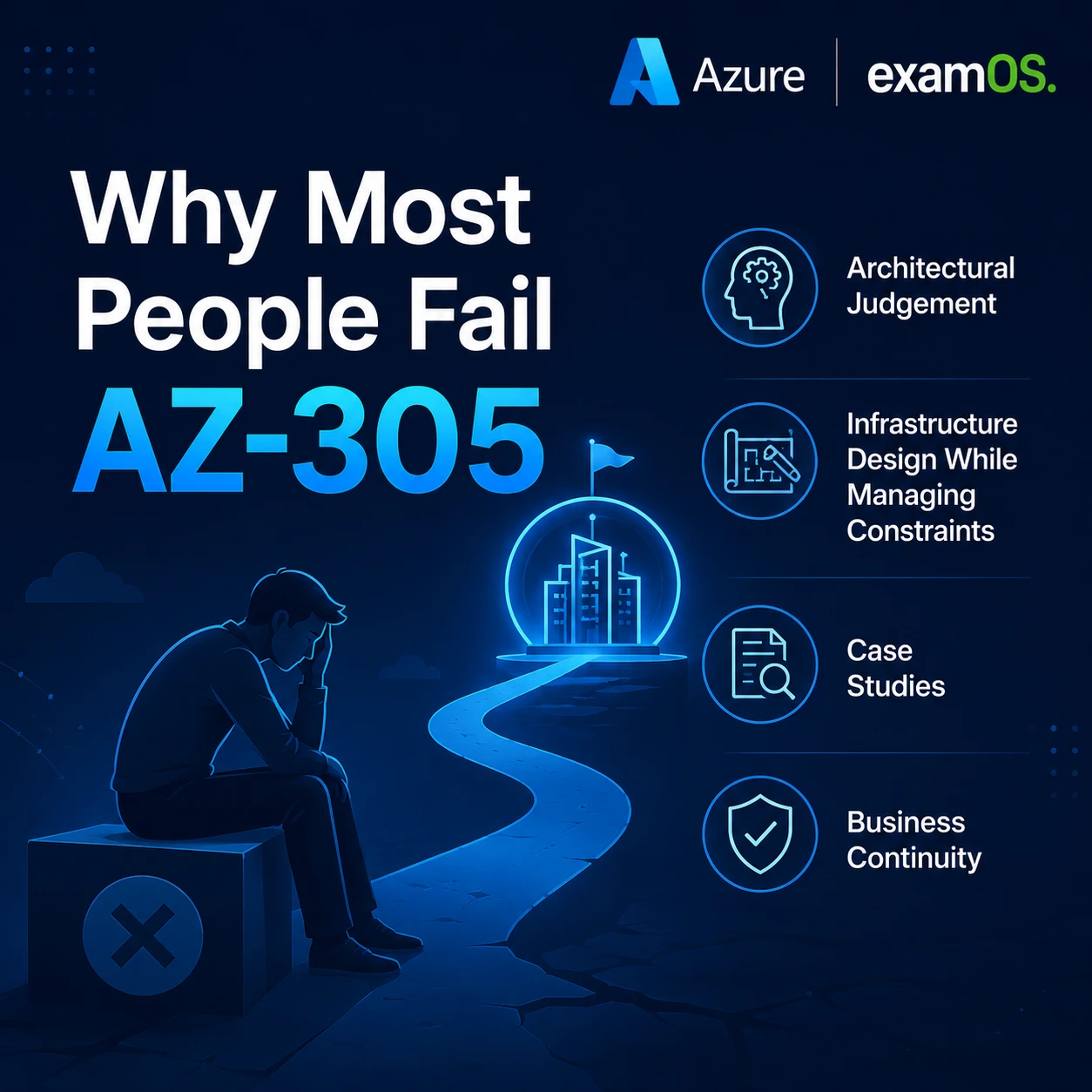
Why Most People Fail AZ-305 (Even After Passing AZ-104)
Passing AZ‑104 feels like progress. You’ve administered identities, networking, VMs. Then AZ‑305 prep begins – material feels familiar, practice questions feel fine, but exam day returns fail. This isn’t rare. The problem isn’t knowledge. It’s the type of thinking required.
👉 Learn more about Solutions Architect Expert: AZ- 305
The Fundamental Shift
- AZ‑104 = administrator exam. “How do I configure this?”
- AZ‑305 = architect exam. “What should I build, and why this instead of that?”
AZ‑104 rewards correctness. AZ‑305 rewards defensibility. Those are different skills.
👉 Learn more about Azure Administrator AZ-104
Reason 1: Treating AZ‑305 as “AZ‑104 With More Services”
Related: How Hard Is AZ-104? Why Most People Underestimate It
Learning more Azure services at the same depth doesn’t bridge the gap. Architectural judgment does. If your prep is mostly absorbing info and testing recall, you’re building the wrong skill.
Reason 2: Underestimating Identity & Governance (25–30%)
Management Groups & Policy inheritance – design hierarchies so compliance applies without over‑restricting. Know policy flow, exemptions, and initiatives vs. individual policies.
Privileged Identity Management (PIM) – when should roles be eligible vs. active? What approval workflows? How to configure access reviews? A scenario requiring “never permanently assigned, manager approval, alerts” tests PIM design, not just existence.
Entra ID tenant design – single vs. multiple tenants? B2B vs. B2C? Hybrid identity with Entra ID Connect sync requirements – the exam tests these design decisions directly.
Reason 3: Data Storage Design Is Harder Than It Looks
Cosmos DB consistency levels – Strong, Bounded Staleness, Session, Consistent Prefix, Eventual. Session consistency = read your own writes globally. Strong = linearizable reads, higher latency. Know the trade‑offs.
Azure SQL vs. Cosmos DB vs. PostgreSQL – ACID transactions with complex relationships → SQL. Horizontal scale, flexible schema, global distribution → Cosmos DB. Existing PostgreSQL workloads → Azure Database for PostgreSQL.
Storage tiers & lifecycle – Hot, Cool, Cold, Archive. Archive requires hours of rehydration – if RTO is short, Archive is out. Read access requirements before choosing a tier.
Reason 4: Business Continuity (10–15%) – Small Weight, Big Mistakes
RTO/RPO as design constraints – RPO = 0 → synchronous replication. RPO = 4 hours → geo‑redundant backups. RTO = 15 minutes → no manual restore processes. Map specific numbers to specific architectures.
Related: What Next After Passing AZ-104?
Azure Backup vs. Site Recovery vs. Geo‑replication
- Backup – point‑in‑time data recovery (accidental deletion, corruption).
- Site Recovery – VM workload failover to another region (minutes to hours).
- Geo‑replication (SQL, Cosmos DB, Storage) – synchronous/near‑sync copies, failover in seconds.
A SQL DB needing zero data loss and failover within seconds → active geo‑replication with failover groups. A VM needing region failover within an hour → Site Recovery.
Reason 5: Infrastructure Design – Constraints, Not Services
Compute selection signals
- Long‑running batch jobs with variable parallelism → Azure Batch
- Event‑driven (<10 min, no infrastructure) → Functions (Consumption)
- Containerized microservices needing orchestration → AKS
- Containers without managing Kubernetes → Container Apps
- Legacy lift‑and‑shift with OS control → VMs
- Web apps without containers → App Service
Matching workload to service – not choosing what you’re comfortable with – is the skill.
Landing zone & hub‑and‑spoke – shared services (firewall, DNS, VPN) in hub VNet. UDRs force inspection. Know when to use Virtual WAN instead of manual hub‑and‑spoke.
Migration scenarios – Framework: assess, migrate, optimize.
- Azure Migrate – assessment & server migration
- Database Migration Service – database workloads
- Azure Data Box – offline transfer >200TB, limited bandwidth, tight deadline
A 200TB migration over 1Gbps with a two‑week deadline points to Data Box, not online migration. Read the constraint.
Reason 6: Case Study Questions – Different Technique
Extended scenarios with multiple questions.
Related: Why Scenario-Based Practice Tests Work
What works:
- Read requirements before background – know what’s needed.
- Flag constraints (budget, compliance, timeline) – they eliminate options.
- Answer only from what’s stated – don’t bring external “best practice” unless required.
- Don’t assume unstated information.
Practice case studies explicitly – they’re different from standard multiple choice.
A Better Preparation Approach
- Prioritise design scenarios over service docs – for every service, ask: when is it the right choice? When is it the wrong choice?
- Study the Well‑Architected Framework seriously – it’s the unifying principle behind AZ‑305.
- Work through wrong answers – keep a log of why you missed each question. Patterns reveal where your judgment is weak.
- Practice daily, not in blocks – 15 minutes of scenario practice daily > 3‑week cram. ExamOS is built around this model.
The Honest Assessment
AZ‑305 is hard because it tests something genuinely difficult: designing systems across multiple dimensions under real constraints. The gap between AZ‑104 and AZ‑305 isn’t a knowledge gap. It’s a thinking gap. Recognise that early, adjust your preparation, and you’ll sit this exam once instead of twice.
Build design judgment with daily scenario‑based practice on ExamOS.
👉 Start Practice Test : AZ- 305
> **Related:** [Do Practice Exams Really Work?](/blog/do-practice-exams-work)