What to Do After Passing the AWS Solutions Architect Associate
Passing the AWS Solutions Architect Associate is a genuine milestone. It’s also where the path forward gets less obvious.
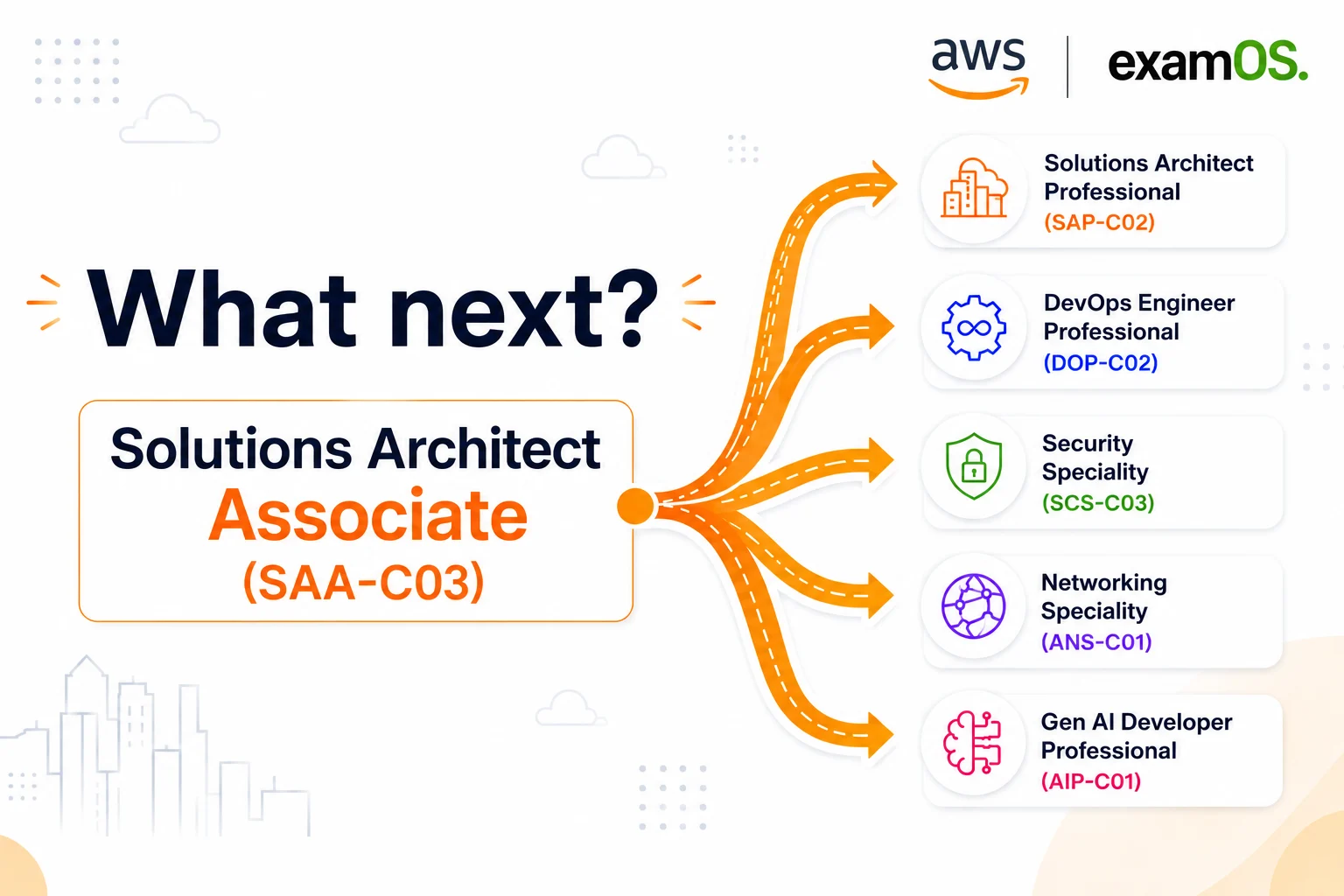
Before SAA‑C03, the decision was simple: study, pass, move on. After it, you’re looking at branching options with no single right answer. Do you go deeper into AWS with the Professional? Broaden into security or networking? Pivot to a different cloud? Pick up a DevOps or Kubernetes cert?
This post helps you reason through the decision yourself.
👉 AWS Solutions Architect Associate : SAA-C03
What SAA‑C03 Actually Proved
You demonstrated competence with core services, understood trade‑offs across compute, storage, database, and networking, and can apply the Well‑Architected Framework at a foundational level.
What it didn’t prove: depth in any specific domain. Security, networking, DevOps, data engineering, cost optimisation – all touched, none covered at production depth.
That gap between broad knowledge and genuine domain depth is where your next move lives.
Four Directions Worth Considering
Related: AWS Solutions Architect Associate vs Professional: What Actually Changes?
1. Go Deeper in AWS
Solutions Architect Professional (SAP‑C02) – tests architectural judgment across complex, multi‑account, hybrid, large‑scale environments. For senior architect or principal engineer roles. It’s substantially harder. Give yourself time if you lack hands‑on experience with AWS Organizations, Transit Gateway, or complex IAM.
👉 AWS Solutions Architect Professional : SAP-C02
AWS Specialty certifications – deep rather than broad: Security (SCS‑C03), Advanced Networking (ANS‑C01), Machine Learning, Data Engineer, Database, SAP on AWS. All are genuinely respected and difficult.
👉 AWS Networking - Speciality : ANS-C01
2. Add a DevOps or Platform Engineering Credential
AWS DevOps Engineer Professional – covers CodePipeline, CloudFormation, Systems Manager, operational best practices. Professional‑level difficulty.
👉 AWS DevOps Engineer Professional : DOP-C02
Kubernetes (CKA / CKS) – hands‑on, no multiple choice. Highly valued for platform/DevOps roles.
👉 Certified Kubernetes Administrator
HashiCorp Terraform Associate – low‑friction signal of IaC fluency.
👉 HashiCorp Terraform Associate
3. Build Multi‑Cloud Breadth
Azure Administrator (AZ‑104) – closest Azure equivalent to SAA‑C03.
👉 Azure Administrator : AZ-104
Google Cloud Professional Cloud Architect – more advanced, complements AWS knowledge, strong in data/analytics.
Multi‑cloud is valuable in consulting or heterogeneous environments. If you’re in a single‑cloud shop, deepening AWS is likely better.
Related: What Next After Passing AZ-104?
4. Specialize in Security
AWS Security Specialty (SCS‑C03) – IAM depth, KMS, CloudTrail, GuardDuty, incident response. Best direct path for cloud engineers moving into security.
👉 AWS Security Speciality : SCS-C03
CompTIA Security+ – vendor‑neutral foundational security knowledge.
👉 CompTIA Security+
How to Actually Decide
Look at the next role you want. Find 3‑5 job postings. Read the preferred qualifications. Certifications that appear repeatedly are worth pursuing.
Ask yourself:
- What are you being asked to do at work that you can’t do well yet? The best next cert often addresses that gap.
- What problems do you want to be solving in two years? Certifications take months; align with where you want to be, not just where you are.
- How much hands‑on experience do you actually have? Professional‑level exams require depth that can’t be substituted by study alone. If you’ve worked hands‑on with AWS for less than two years, attempting SAP‑C02 immediately is risky.
The Experience Problem Most Candidates Underestimate
The Associate tests identifying the right decision in a contained scenario. Professional and Specialty tests require reasoning about complex systems with competing constraints. That gap needs experience, not just study.
If you’re early in your career, build deliberate hands‑on experience in your target domain, and let the certification follow that work – not lead it.
Related: Top Cloud Certifications Ranked by Job Market Value
Maintaining What You Already Know
AWS releases hundreds of updates per year. Knowledge decays if you don’t use it. Short, regular engagement – scenario‑based practice, reading AWS blogs, working on projects – keeps your foundation sharp.
Platforms like ExamOS are built around daily scenario engagement, so you’re not starting from scratch with each new certification cycle.
Practical Timelines (Rough Guidelines)
| Path |
Timeline |
Focus |
| Associate → Solutions Architect Professional |
6‑12 months (2+ years hands‑on) |
Organizations, hybrid, complex IAM, migration |
| Associate → Security Specialty |
4‑8 months |
IAM depth, KMS, CloudTrail, detective controls |
| Associate → DevOps Engineer Professional |
6‑10 months |
CodePipeline, CloudFormation, Systems Manager |
| Associate → CKA |
3‑6 months |
Cluster admin, networking, storage, RBAC |
| Associate → AZ‑104 |
2‑4 months |
Azure networking, Entra ID, compute, storage |
The Credential Isn’t the Destination
Certifications are proxies for capability. The underlying capability is what matters in the work. The best next certification after SAA‑C03 is the one that closes a real gap between what you know today and what you need to know to do the work you want.
Figure out that gap first. The credential choice follows naturally.
Keeping your AWS knowledge sharp between cert cycles matters. Explore daily scenario‑based practice on ExamOS and build the consistent learning habit that makes every follow‑on exam easier.
👉 AWS Solutions Architect Associate : SAA-C03