Blog Post
What Next After Passing AZ-104?
Passed AZ-104? Here's an honest breakdown of where to go next — whether that's specialising, going enterprise-scale with AZ-305, or branching into security and networking.
Read Strategy08-May-2026117 views
Blog Post
Passed AZ-104? Here's an honest breakdown of where to go next — whether that's specialising, going enterprise-scale with AZ-305, or branching into security and networking.
Checking sign-in status...
Your AZ-104 is done. Now what?
Azure's certification map is wide. Security, networking, architecture, identity, AI — there is a path for every direction your career is heading. The question is not which certificate looks best on a resume. The question is which one forces you to think at the level your next role demands.
Most people search for "hardest cert" or "highest paying cert" and pick based on that. That's the wrong frame.
The right question: what kind of work do you want to be doing in 12 months — and which certification forces you to think at that level?
AZ-104 proves you can administer Azure. What comes next depends on whether you want to go deeper into a specialisation, broader into architecture, or heavier into security. Each path is legitimate. Each leads somewhere different.
Before picking what's next, be honest about what you just demonstrated.
AZ-104 tested your ability to manage Azure resources — virtual machines, storage, networking, identity, and monitoring. It's an administrator credential. You proved you can keep the lights on, configure services correctly, and troubleshoot when things break.
What it didn't test: designing systems from scratch, making architecture trade-offs at scale, or securing enterprise environments with thousands of users across multiple tenants.
That's not a criticism. It's just the honest scope of the exam. Your next move should plug into whichever of those gaps matters most for your career.
Path 1: Go broader — AZ-305 (Azure Solutions Architect Expert)
Related: Why Most People Fail AZ-305 (Even After Passing AZ-104)
This is the natural next step for anyone moving toward senior or lead roles. AZ-305 sits one level above AZ-104 and tests your ability to design Azure solutions, not just manage them.
The shift in thinking is significant. AZ-104 asks: how do you configure this? AZ-305 asks: given these business requirements, compliance constraints, and budget, what should the architecture look like — and why?
Scenarios get longer. Trade-offs get messier. All four answers can look correct. You're no longer picking the right service — you're defending the most appropriate architecture for a situation that doesn't have a clean textbook answer.
Go this route if you're already involved in infrastructure decisions at work, or if architect is somewhere in your job title horizon.
👉Learn more about Solutions Architect Expert: AZ- 305
Path 2: Go deeper — Specialisation certifications
Azure has a growing set of specialty exams that sit alongside the administrator and architect tracks. The most common post-AZ-104 choices:
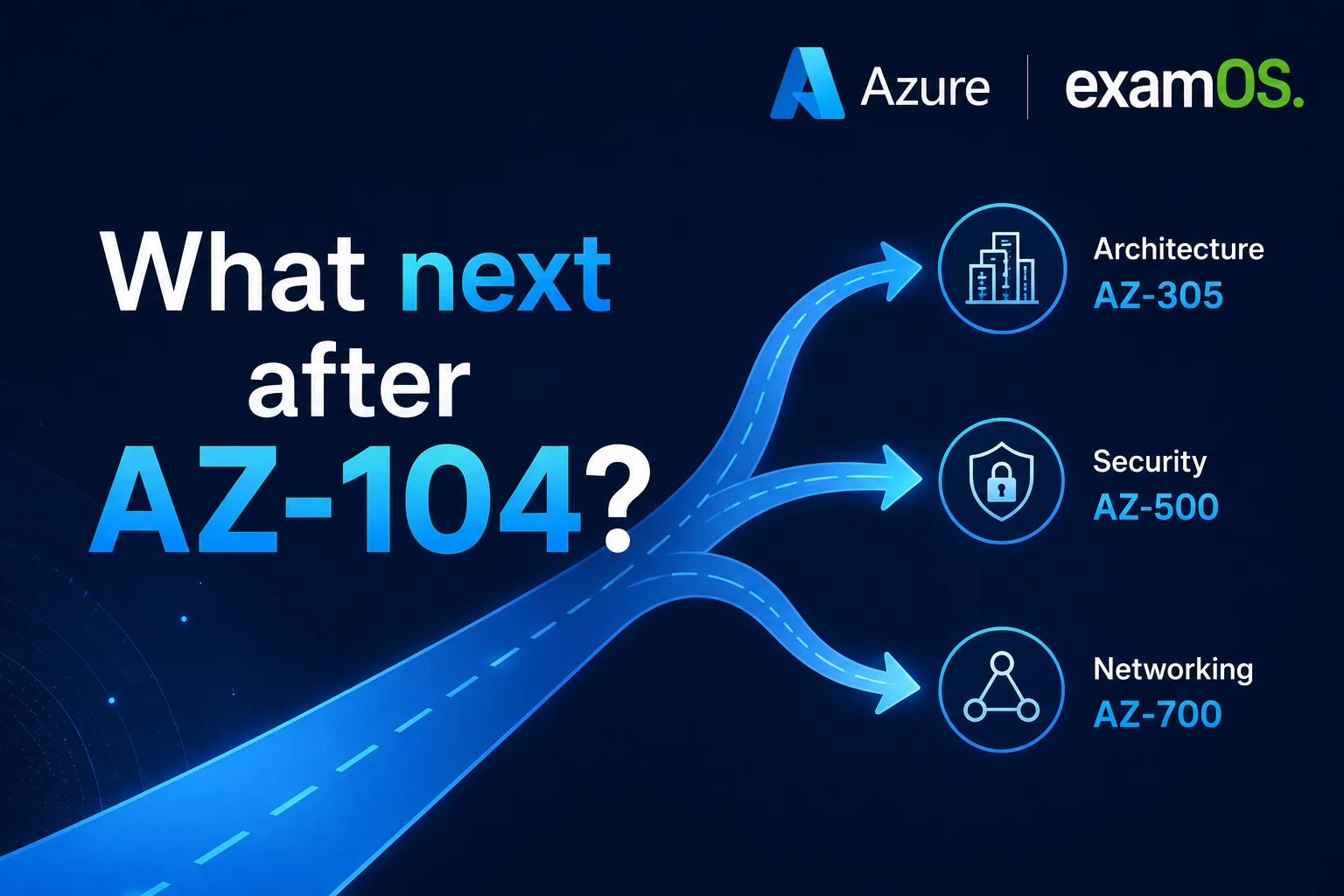
Security Engineer Associate : AZ-500 — identity, threat protection, governance, and securing workloads. High demand. Pairs naturally with the IAM and RBAC knowledge you built in AZ-104. Network Engineer Associate : AZ-700 — deep networking: virtual WAN, ExpressRoute, load balancing, DNS, hybrid connectivity. If you find yourself spending most of your time in the networking layer, this is the logical move.
Specialisations carry real weight in hiring if the role is domain-specific. A security engineer role will care more about AZ-500 than AZ-305.
Path 3: Go cross-platform — AWS or GCP fundamentals
This one surprises people, but it's increasingly relevant. Multi-cloud environments are common. Many enterprises run workloads across Azure and AWS simultaneously.
If your organisation uses both, or if you want to stay competitive across a wider range of roles, pairing AZ-104 with AWS Solutions Architect Associate gives you something most candidates don't have: the ability to have an honest conversation about trade-offs between platforms.
It's not for everyone. But if breadth is your edge, this path is worth considering.
AWS Solutions Architect Associate : SAA-C03
Google Cloud Professional Cloud Architect Associate : PCA
Go to AZ-305 if:
Go to AZ-500 if:
Go to AZ-700 if:
Go cross-platform if:
Every path above rewards the same thing: scenario-based thinking.
Knowing that Azure Firewall supports FQDN filtering is trivia. Knowing when to use Azure Firewall vs. a Network Virtual Appliance vs. NSGs for a given workload, threat model, and budget — that's the skill the exams test, and the skill that matters in real design conversations.
This is why passive studying rarely gets you there. Watching a course builds familiarity. Doing realistic scenario practice builds judgment. The gap between those two things is where most exam points are lost — and where most on-the-job mistakes happen.
Daily scenario practice closes that gap faster than anything else. ExamOS is built around short, realistic scenarios that train the reasoning process until it becomes automatic.
AZ-305 is the most broadly recognised next step. It carries weight in senior hiring — lead engineer, solutions architect, principal consultant. It signals you can design at scale, not just operate.
AZ-500 opens doors specifically in security-focused roles. It's increasingly preferred in enterprise and regulated environments where security posture is a board-level concern.
AZ-700 is narrower but valuable in the right context. Network engineers with deep Azure expertise are genuinely hard to find.
None of these prove you build well in production. They prove you can reason about systems correctly under structured conditions. Pair them with real project work and the credential becomes much harder to dismiss.
| Situation | Recommendation |
|---|---|
| Want to move into architecture roles | AZ-305 |
| Security is your primary domain | AZ-500 |
| Networking is where you spend your time | AZ-700 |
| Organisation uses Azure + AWS | AZ-104 + AWS SAA |
| Want the fastest path to Expert level | AZ-104 → AZ-305 |
| Regulated industry, compliance-heavy work | AZ-500 first |
| Unsure, want the most versatile next step | AZ-305 |
Related: How Hard Is AZ-104?
1. Know the exam blueprint — Microsoft publishes detailed skills measured documents for every exam. Weight your study time by domain percentages, not by what you find most interesting.
2. Build on what you know — AZ-104 gave you a strong foundation in identity, networking, and compute. Don't start from scratch. Identify where the new exam goes deeper than what you already covered.
3. Practice scenarios daily — 15 minutes a day of realistic questions trains the reasoning process. When you get something wrong, don't memorise the answer. Ask: What information should have pointed me to the right answer? Which constraint did I miss? What assumption was wrong? Your error patterns are more useful than any flashcard deck.
4. Review wrong answers seriously — most candidates skim the explanation and move on. That's the most expensive habit in exam preparation.
If you want structured daily practice for AZ-305, AZ-500, or AZ-700, ExamOS is built exactly around this approach.
Azure certifications have a shelf life. Microsoft updates exams regularly, and the platform itself evolves fast. The candidates who stay sharp aren't the ones who crammed hardest before an exam — they're the ones who kept the learning habit going after it.
The reasoning skills you build preparing for these exams — reading a messy scenario, identifying the real constraint, picking the most defensible option — those transfer directly to architecture reviews, incident post-mortems, and client conversations.
That's the real return on the time you're investing. The cert is just the proof of work.
👉 Other Related exams:
Security Engineer Associate : AZ-500
Network Engineer Associate : AZ-700
DevOps Engineer Expert : AZ-400
Solutions Architect Expert: AZ- 305
Related: Top Cloud Certifications Ranked by Job Market Value