Blog Post
Why You Are Wasting Your Time With AI Practice Tests
Using AI practice tests for AWS or Azure prep? Learn why AI-generated questions fail to prepare you for real exams and how to study effectively instead.
Read Strategy27-Sep-202661 views
Blog Post
Using AI practice tests for AWS or Azure prep? Learn why AI-generated questions fail to prepare you for real exams and how to study effectively instead.
Checking sign-in status...
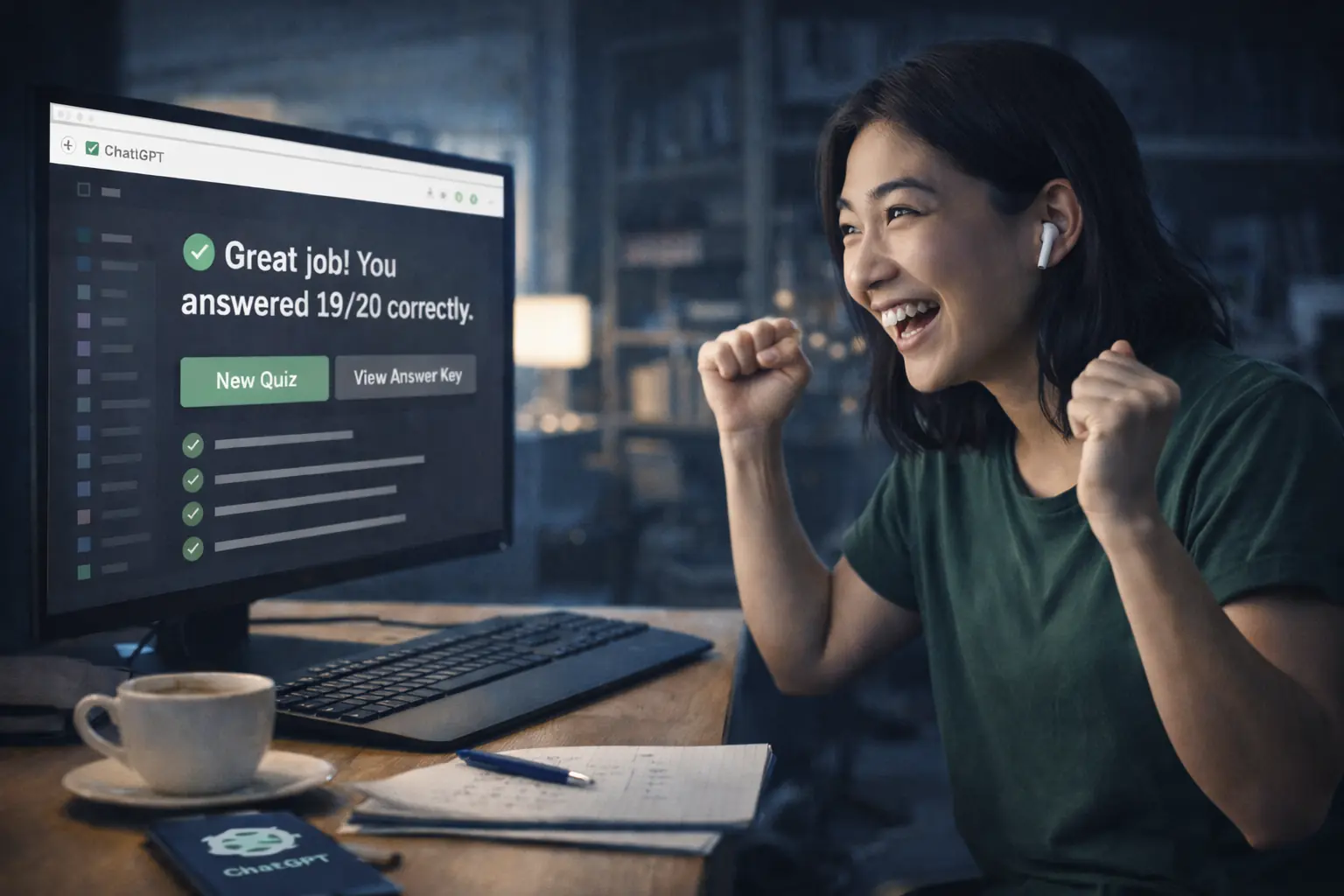
AI-generated practice tests feel productive. They are often the opposite. You open ChatGPT, ask for 20 AZ-104 questions, and get a full quiz in seconds. It feels like a hack. It is closer to a trap.
Large language models are built to sound authoritative. They are not built to be factually correct. When you ask one to generate cloud certification questions, it invents features, hallucinates service limits, and mixes AWS and Azure concepts together.
You will not know when it is wrong. That is the problem.
Related: How to Study for IT Certifications ↗
LLMs predict the next likely token. They do not verify facts against vendor documentation.
Ask an AI for questions about AWS IAM policies or Azure networking, and you will get answers that look precise. A quota that does not exist. A service limit that changed last year. A feature that only exists in a different platform.
A learner cannot spot these errors without checking the official documentation. Most candidates do not check. They memorize the wrong answer with confidence and walk into the exam prepared for a version of the platform that does not exist.
Real certification exams do not ask what an S3 bucket is. They describe a company scenario, list cost and security constraints, and offer four plausible answers. Your job is to find the best one.
Microsoft, AWS, and Google exams use scenario-based questions as the dominant format. The PMP exam is entirely scenario-based. Candidates who memorized definitions fail because the exam never asks for definitions.
AI-generated questions default to trivia. They test whether you know a service name, not whether you can reason about trade-offs. You pass the AI quiz, feel confident, and then hit questions that require architecture judgment you never practiced.
Related: Scenario-Based Practice Tests ↗
Cloud platforms change constantly. Services are renamed. Features are deprecated. Best practices shift month to month.
AI models are trained on historical snapshots of the internet. Their knowledge is frozen at the training cutoff. Microsoft retired AZ-500 and replaced it with SC-500. AWS retired the Security Specialty SCS-C02 and replaced it with SCS-C03. Vertex AI Agent Engine was rebranded to Agent Runtime on the Gemini Enterprise Agent Platform.
Ask an AI about any of these and it will often describe the retired version. You study stale content with no warning.
AI is a useful study tool when used correctly. It is a poor test engine.
Use AI to:
Do not use AI to generate practice questions. The accuracy is not there, and you have no way to verify what you are learning.
Once you have learned the concepts, your job shifts from absorbing information to making decisions under pressure. You need practice that mimics the format, ambiguity, and constraint of the real exam.
Scenario-based practice forces you to reason. It presents a situation with trade-offs and asks for the best decision. It teaches you to spot the constraint that rules out three of the four answers.
Here is a technique that separates candidates who pass from candidates who struggle.
Stop obsessing over the correct answer. Most candidates check if they got a question right and move on. That wastes the question.
The real learning happens when you explain why the other three options are wrong.
If you can articulate why Option B is too expensive, why Option C violates a security policy, and why Option D uses a deprecated service, you understand the architecture. That is the level of comprehension these exams measure.
Related: Do Practice Exams Work ↗
ExamOS is built around scenario practice, not recall.
The Daily Sprint gives you seven questions in seven minutes. It adapts to your weak areas automatically, so the questions you see are the ones you need most. The Readiness Score tracks your accuracy, coverage, and recency across every domain, so you know when you are prepared to book.
Insights shows domain-by-domain scores after every session. Your weakest area becomes tomorrow's focus. Mock Exam simulates the full exam across all domains, weighted exactly as the official syllabus.
Every question follows a Scenario → Constraints → Decision Required structure. You reason through trade-offs instead of reciting definitions.
AI models predict likely text rather than verifying facts. They invent service limits, hallucinate features, and mix up services across cloud platforms. Their training data is also frozen at a cutoff date, so they describe retired exams and deprecated services as current.
Use AI as a tutor, not a test engine. It is useful for explaining complex documentation in plain language, generating example policies or configuration files, and debugging code you are writing. Always verify factual claims against official vendor documentation.
Use scenario-based practice that mirrors the real exam format. Focus on explaining why the incorrect options are wrong, not just confirming the correct one. That is the reasoning skill the exam measures.
ExamOS uses the Daily Sprint for short daily practice, the Readiness Score to track progress across domains, and Mock Exam for full-length exam simulation. Insights shows your weakest domains after every session so you always know what to study next.
Stop guessing with AI-generated questions. Start with a free Daily Sprint on ExamOS and see where your knowledge actually stands.