Blog Post
Why Most People Fail at Learning AI Engineering (And How to Fix It)
Trying to become an AI engineer? Here’s why most people fail and a practical approach to actually building real AI skills.
Read Strategy22-Mar-202641 views
Blog Post
Trying to become an AI engineer? Here’s why most people fail and a practical approach to actually building real AI skills.
Checking sign-in status...
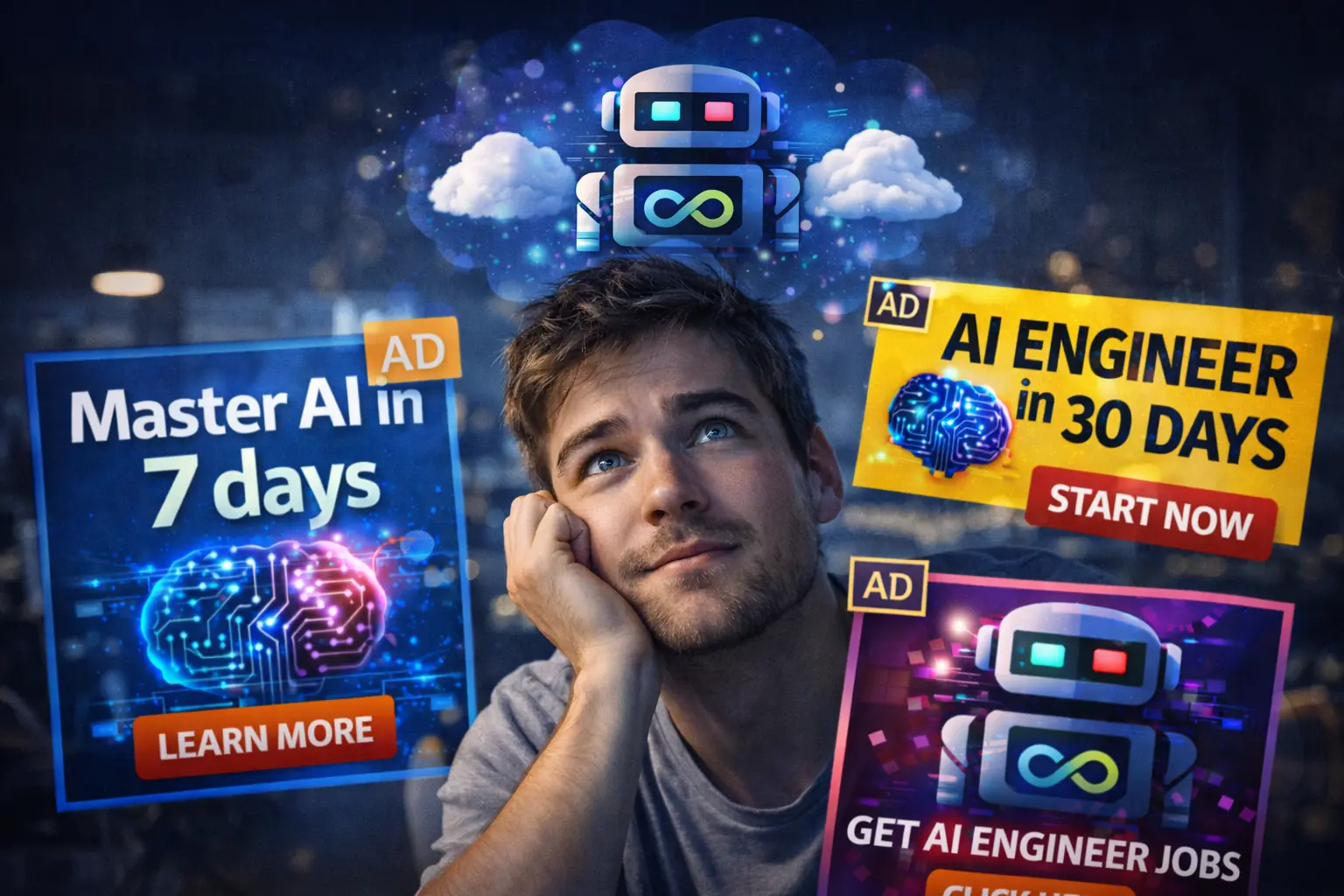
AI engineering is everywhere right now. The internet is flooded with promises like "Become an AI Engineer in 30 Days" or "Master LLMs in one weekend." It creates the illusion that if you just follow the right tutorial, you will be job-ready in a month.
But the reality is stark: most people trying to transition into AI engineering never make it past the beginner stage. This isn't because the concepts are impossibly hard, but because their approach to learning the technology is fundamentally flawed.
Here is why most learners get stuck, and how you can actually build reliable AI engineering skills.
The most common trap for beginners is treating AI as a collection of tools rather than an architectural system. They rush to learn LangChain, OpenAI APIs, and vector databases, memorizing the syntax to connect these pieces as quickly as possible.
While they can build something that looks impressive on the surface, their knowledge is incredibly brittle. If you ask them why a model hallucinates, what is actually happening during inference, or exactly how semantic search improves a response, the illusion shatters.
Because they focused strictly on usage, they learned how to consume APIs, not how AI systems actually work.
This brittle knowledge leads directly into the AI version of tutorial hell. You follow a guide to build a chatbot, connect a vector database, and wrap it in a clean UI. Everything works perfectly, and it feels like massive progress.
But the moment you try to build a custom application without a step-by-step guide, you hit a wall. Why? Because tutorials abstract away the most critical parts of engineering: decision-making, debugging, and evaluating trade-offs. The friction that tutorials remove is exactly where the real learning is supposed to happen.
The AI ecosystem evolves at a breakneck pace. New models, frameworks, and best practices drop weekly. If your learning strategy is simply to "keep up with the latest tools," you will be locked in a perpetual state of feeling behind.
Tools are not foundations. What remains stable are the core principles. You need to deeply understand:
Just like in cloud computing, you must focus on learning the system architecture, not the framework syntax.
If you want to move past the beginner stage, you need to change your approach. Follow this structured framework to build actual competence.
Do not try to master the entire AI ecosystem at once. Pick a narrow, tangible goal—like building a document summarizer or a simple Q&A bot. Learn only the specific concepts required to get that project off the ground.
Use tutorials as reference material, not as a script. Once you have a basic application running, try to modify it. Intentionally break the code, or add a feature that wasn't included in the video. This forces you to understand the underlying mechanics.
If your RAG pipeline works flawlessly on the first try, you aren't pushing the boundaries of the technology. You need to encounter slow queries, hallucinated answers, and token limit errors. When the system returns a bad response, ask yourself: Why did this fail, and how can I engineer a guardrail for it? Debugging these failures is what turns you into an engineer.
In cloud architecture, we rely on structured practice tests—like ExamOS—to validate our foundational knowledge. In AI, you must hold yourself to that exact same standard.
While building projects gives you practical experience, you also need to test your theoretical foundation. Do you actually understand context limits, embedding models, and tokenization? Using structured practice tests (like those in ExamOS for vendor-specific AI certifications) forces you to answer these questions under pressure. If you cannot justify your design choices over alternative methods without guessing, you are still operating at the surface level.
Do not jump from building a simple Q&A bot to trying to build an AGI agent. Stay with your initial project and make it robust. Add authentication, refine the retrieval quality, implement caching, and handle edge cases. Depth of knowledge always beats superficial complexity.
Related: Why You Are Wasting Your Time With AI Practice Tests
When hiring managers look for AI engineers, they are not looking for developers who have skimmed documentation for ten different frameworks.
They want engineers who understand architectural trade-offs. They want people who can debug non-deterministic systems, and who know how to build reliable applications around unpredictable models. That expertise only comes from building, breaking, and refining systems over time—not from watching videos.
Stop asking, "What AI tool should I learn next?" and start asking, "What problem can I solve better than I did yesterday?"
If you are ready to start building immediately: → Read: Top 5 AI Projects for beginners
AI engineering is not about chasing the latest model release. It is about deeply understanding how systems behave, validating your knowledge continuously (this is where regular ExamOS practice keeps you sharp), building things that break, and fixing them repeatedly.
Start small, build consistently, and think deeply. That is how you bridge the gap between AI enthusiast and AI engineer.
Related: The 1-Hour Daily Learning Plan