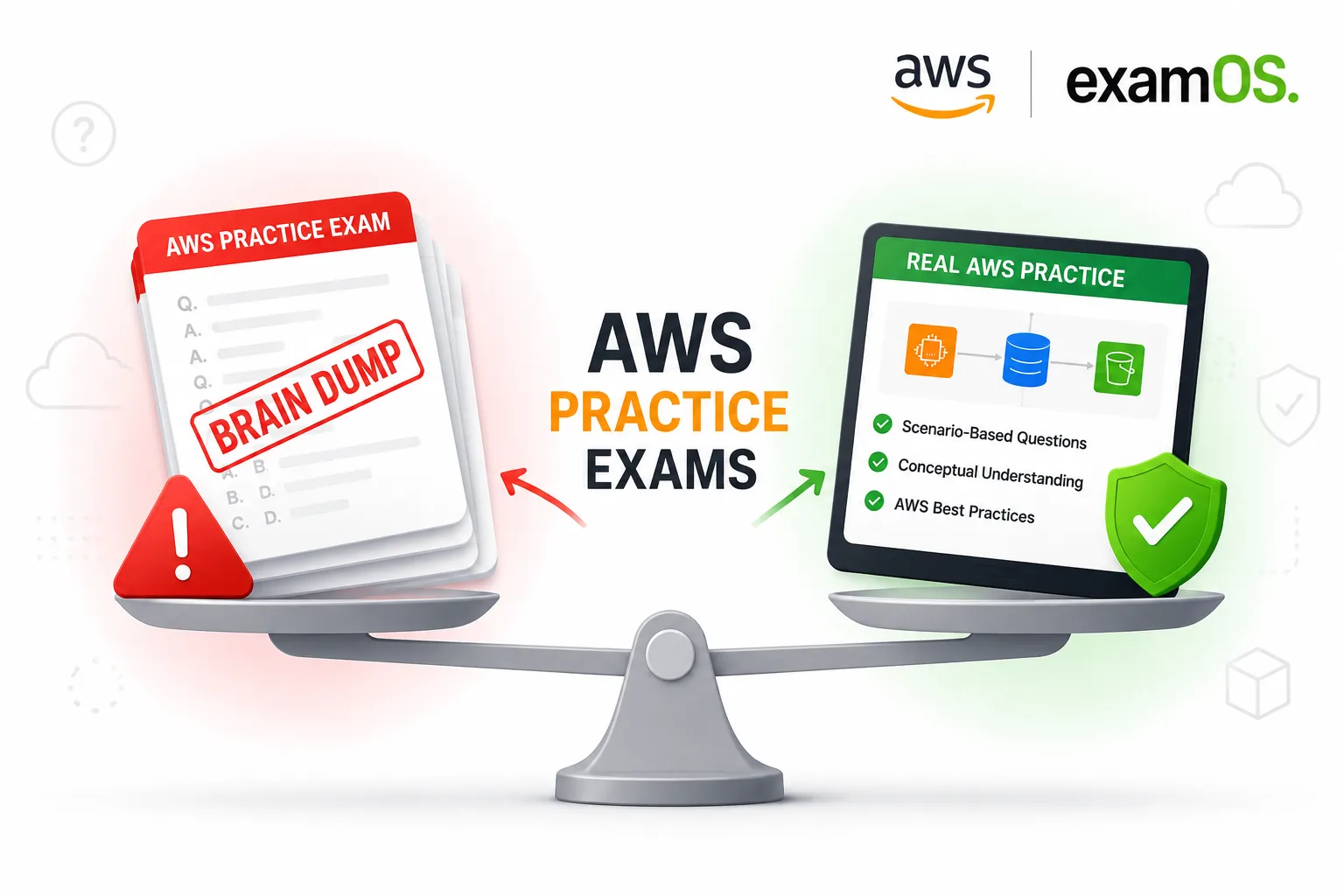
What a Brain Dump Actually Is
A brain dump is a set of real exam questions recalled and published by recent test‑takers. It’s a violation of AWS’s candidate agreement. The practical problem: brain dumps train recognition. You see a question, remember the answer, click. No reasoning required.
On the actual exam, scenarios are fresh. Distractors are designed to catch pattern‑matchers.
Brain Dumps vs. Low‑Quality Practice Exams
Not every bad resource is a brain dump. There’s a spectrum.
Brain dumps – leaked real questions. Violate terms; don’t prepare you.
Related: Are Exam Dumps Safe? The Hidden Risks Nobody Talks About
Low‑quality practice exams – legally created but poorly designed. Common signs:
- Trivia instead of judgment (“Maximum S3 object size?”)
- Obvious wrong answers you can eliminate in seconds
- Explanations that just repeat the correct answer
- Outdated service limits or behavior
- No connection to real architectural decisions
Both categories give you confidence without capability. The most dangerous outcome isn’t failing – it’s passing on brain dumps, believing you’re prepared, and then making poor production decisions.
How to Spot a Brain Dump
The questions feel instantly familiar – a flag that content is recycled.
Thin answer explanations – “RDS is correct because it’s a managed database” isn’t an explanation. Good ones walk through trade‑offs and why alternatives fail.
Unrealistically short scenarios – Two‑sentence questions with three obvious wrong answers test vocabulary, not judgment.
Suspiciously large question banks – 1,000+ “unique” questions usually means volume padding (slight rewordings, trivia). A smaller bank of 200 well‑crafted scenarios is vastly better.
No visible update history – No mention of last review or exam version means stale content.
Why This Matters More Than You Think
- Hiring managers discount the credential when they meet certified candidates who can’t reason.
- You underperform in the role – credential gets the interview, judgment keeps the job.
- You waste prep time reinforcing wrong habits.
- You may need to retake – AWS rotates content to invalidate memorised sets.
What Good AWS Practice Looks Like
The goal isn’t to see every possible question. It’s to build the reasoning process so you can work through questions you’ve never seen.
Related: Do Practice Exams Really Work?
Scenario‑Based Questions With Real Constraints
Low‑quality: “What service for serverless compute?” (EC2, Lambda, ECS, Fargate)
Good: A company runs a document processing pipeline triggered by S3 uploads. Processing takes 3–12 minutes. They want minimal overhead and pay only for compute time used. Which approach fits?
– Requires reasoning about Lambda’s 15‑minute limit, Step Functions, and what “operational overhead” means.
Explanations That Teach Architecture
A good explanation tells you:
- Why the correct answer is right for this scenario
- Why the closest wrong answer fails (often more useful)
- What architectural principle underlies the decision
- When the “wrong” answer might be correct in a different context
Consistent Daily Practice Over Marathon Sessions
15 focused minutes every day beats a six‑hour cram every two weeks. Spaced practice builds durable understanding. Marathon sessions build short‑term familiarity that decays quickly.
ExamOS is built around short daily sessions, scenario‑based questions, and progress tracking on specific gaps – not just aggregate scores.
Track the Right Metrics
A 78% on a practice exam tells you almost nothing. Knowing you consistently miss multi‑region failover or IAM permission boundary questions tells you exactly where to focus.
How to Audit Your Current Practice Resources
- Pull five random questions – Do they require reasoning or just recognition? Could you answer by eliminating obvious wrongs? Does the explanation explain trade‑offs?
- Search a question verbatim – If exact matches appear on brain dump forums, ditch the resource.
- Check update history – No last‑review date? Assume stale.
- Look for domain coverage – Are cost optimisation or security proportionally covered?
Related: Why Scenario-Based Practice Tests Work
Resources Worth Using
- AWS’s own practice materials – Low volume, high signal.
- Well‑Architected Framework & architecture blogs – Build mental models.
- Hands‑on labs – Real experience makes exam scenarios familiar.
- Curated scenario‑based platforms – Look for transparency about question methodology and update frequency.
For daily scenario‑based practice, ExamOS focuses on reasoning through AWS scenarios consistently.
The Actual Goal
Passing the exam is a milestone, not the destination. The engineers who get the most from AWS certifications come out thinking differently about architecture – internalising the Well‑Architected pillars, able to justify trade‑offs in a design review.
Prepare for that conversation, not just the test.
👉 Popular AWS Pratice Exams:
AWS Cloud Practitioner : CLF-C02
AWS Solutions Architect Associate : SAA-C03
AWS Solutions Architect Professional : SAP-C02
AWS Developer Associate : DVA-C02
Related: How to Know If You're Actually Ready for Your Certification Exam
Related Reading